

How To Write Online Course Titles With ChatGPT
Increase your online course sales with ChatGPT's 13 effective strategies for crafting captivating titles. Download the prompts template and write titles faster.

Most digital products don’t fail because poor quality. They fail because nobody wanted them in the first place.
That’s why product research is one of the most important steps before you create an ebook, course, software, or any other digital product.
Traditional product research can take days or even weeks. Using ChatGPT for Product Research can speed up this process!
However, It won’t replace real market research or customer validation!
But it can help you:
In this guide, I will show you 7 ChatGPT prompts for product research. Always use these prompts to find better product ideas before building any product
Most people ask ChatGPT to generate product ideas based on a broad topic.
Great products solve real problems. Don’t brainstorm random ideas! Start by finding what people are actually struggling with.
The more painful the problem, the greater the opportunity to build something valuable.
Use this prompt:
Give me 10 problems most people have when it comes to this niche. Go deep and specific with this.

Niche: [Niche]
Instead of starting with assumptions, you’re asking ChatGPT to identify recurring customer problems.
These problems become the foundation for every product idea you create afterward.
Instead of broad suggestions like “create an AI course”, ChatGPT finds specific customer problems.
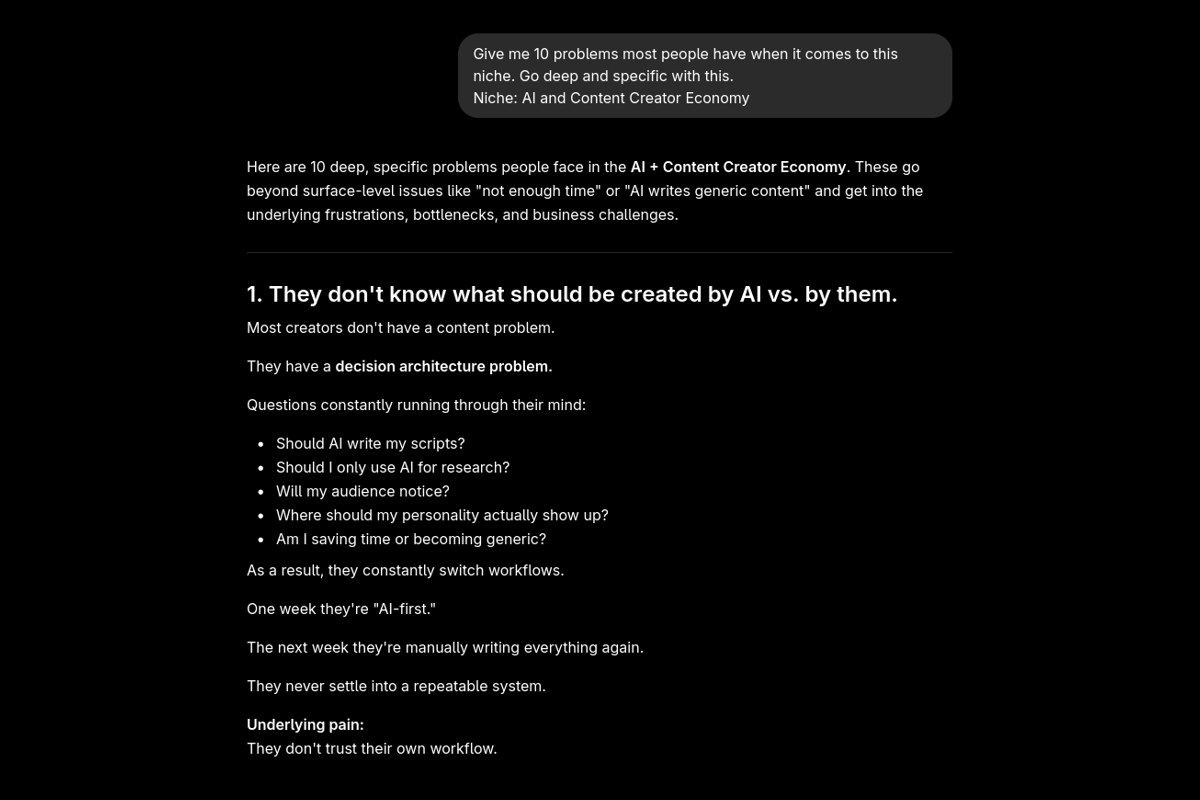
For example:
What makes this prompt especially valuable isn’t just the list of problems.
It also explains each problem and includes examples of the questions potential customers are asking.
Those questions are gold.
Why?
Because they’re often the exact phrases your audience types into Google, YouTube, Reddit, or asks inside other communities.
Even better…
Those questions can become:
In other words, one prompt can generate ideas for your product and your marketing.
Not every problem fits every product.
Software solves different problems than an ebook.
Likewise, a Notion template solves different problems than a coaching program.
This prompt narrows the research to problems your product format can solve.
Give me 10 problems most people have when it comes to this niche that can be solved with this type of product. Go deep and specific with this.

Niche: [Niche]
Product Type: [Product Type or Format]
It filters ideas based on what you’re actually planning to build.
That means fewer unrealistic ideas and more practical ones. Ideas that you can create in that format and become profitable products.
Let’s stick with the AI & Creator Economy niche.
Suppose you want to create a PDF Guide.
Instead of asking ChatGPT for general problems, ask it to identify problems that can realistically be solved with a PDF guide.
For example:
Notice how the problems are filtered by the product format.
A PDF guide can teach a framework, process, or system, but it can’t automate tasks like a SAAS or provide personalized feedback like coaching.
By narrowing the research to your chosen product format, you’ll uncover ideas that are much more practical and much easier to turn into a product.
Finding problems is not enough. You need evidence that the problem actually exists.
This is where many creators skip an important step. They assume demand instead of validating it.
Use ChatGPT to gather supporting research before moving forward.
Give me 10 real stats and data points that back this is a real problem for people. Include the sources and links for each. Use clear stats like: 80% of people... 50% struggle with... 20% don't...

The problem is: [Problem]
Statistics add supporting evidence and confidence to your research.
They also help you prioritize ideas based on the most relevant issues and pain points.
Your product must have impact either by the audience your serve (numbers) or by how hard the problem is to solve.
When ChatGPT generates the results, you’ll usually get:
That summary is especially useful.
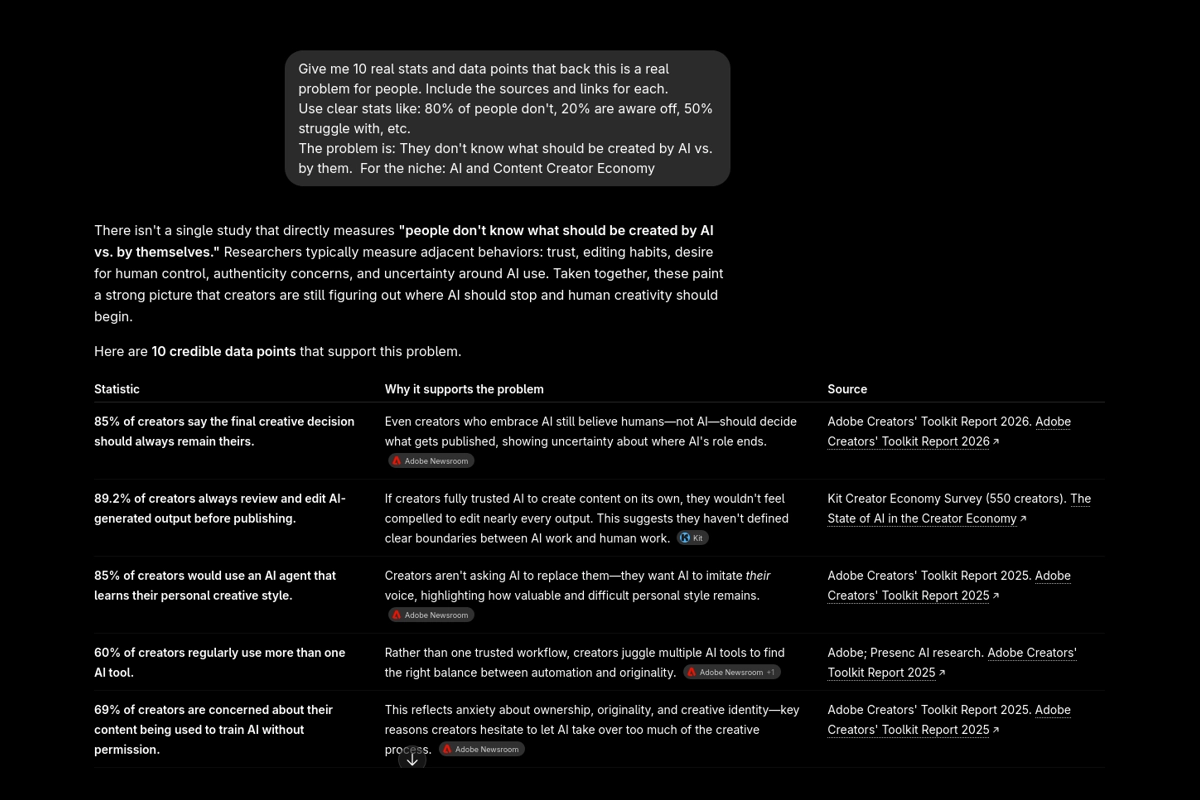
Instead of reading through dozens of reports, you can quickly identify which statistics are the most persuasive.
Those numbers often become your strongest marketing angles.
For example, if research shows that 68% of creators spend more than five hours per week editing AI-generated content, you’ve immediately identified a compelling reason for someone to buy a product that solves that problem.
Just remember to Always verify every statistic using the original source.
ChatGPT is excellent at summarizing information, but you should never publish statistics without confirming they’re accurate and up to date.
After brainstorming several ideas, you’ll need to decide which one deserves your time.
Score every idea against a consistent set of criteria.
Use the following Criteria to evaluate if my product ideas are viable. The ones that fit more boxes should be ranked higher.

Product Criteria: [Product Criteria]
Product Ideas: [Product Ideas]
Here’s an example of the criteria I use when evaluating digital product ideas:
| Product Criteria | Why It Matters |
|---|---|
| Solves a real problem or need | People pay to solve meaningful problems |
| Demand is supported by keyword research | Indicates consistent market interest |
| The audience can afford the solution | Demand doesn’t always equal purchasing power |
| Active conversations exist on social media | Makes marketing much easier |
| The market isn’t overly saturated | Creates room for differentiation |
| You can build a better solution | Competitive advantage matters |
| There is room for future products | Helps build a long-term business instead of a one-off sale |
| The niche has long-term potential | Avoids chasing short-lived trends |
It forces you to evaluate ideas based on facts.
As much as you may like a certain topic, it might be less viable than others.
ChatGPT should support your decision not make it for you.
For example, after validating several AI-related problems, you could paste your strongest ideas or even the statistics from Prompt #3 into ChatGPT and ask it to score each one.
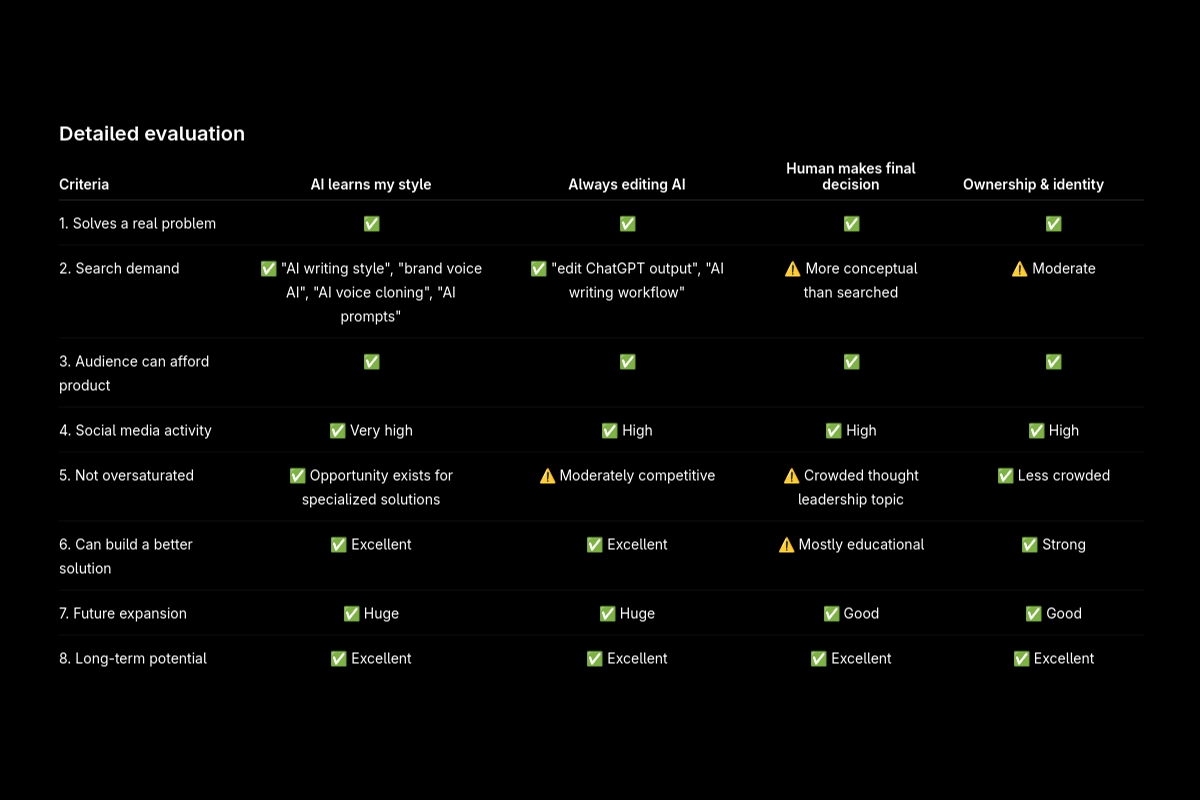
The result is usually a ranked table explaining why one opportunity is stronger than another.
That makes it much easier to prioritize your next project. A simple scorecard forces you to make decisions based on evidence.
Knowing what people struggle with is useful.
Knowing why they struggle is even better.
Understanding your audience helps you write better copy for
Use this prompt:
Write a detailed list of customers' pain points, problems, and deep emotional desires for the following niche and problem. Imagine their private journal entries, capturing their daily struggles and aspirations.

Niche: [Niche]
Problem: [Problem or Data Point]
Instead of focusing only on facts…
It digs for motivations, frustrations, fears, and aspirations.
Those emotional insights often become your strongest marketing messages.
Compare ChatGPT’s output with real customer reviews. Look at Reddit discussions, and YouTube comments to identify recurring themes.
Continuing with our AI & Creator Economy example, let’s use this problem:
Teach AI to sound like you
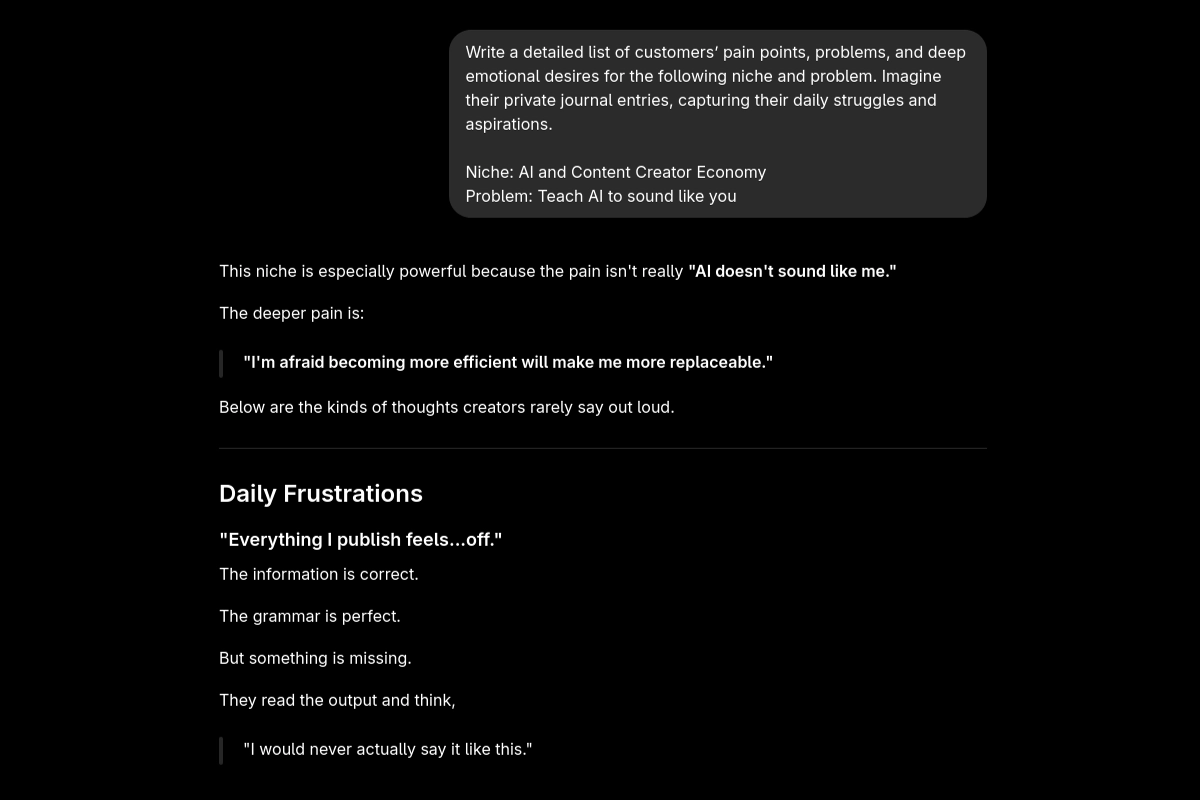
Instead of returning generic pain points like “users struggle with AI writing,” ChatGPT starts uncovering what people are actually feeling.
For example:
Those aren’t just problems. They’re buying motivations.
Look beyond the obvious.
Pay attention to recurring emotions like frustration, overwhelm, fear, embarrassment, or the desire to save time.
Those emotional insights become the foundation for your:
The better you understand your audience…
The easier it becomes to write copy that resonates.
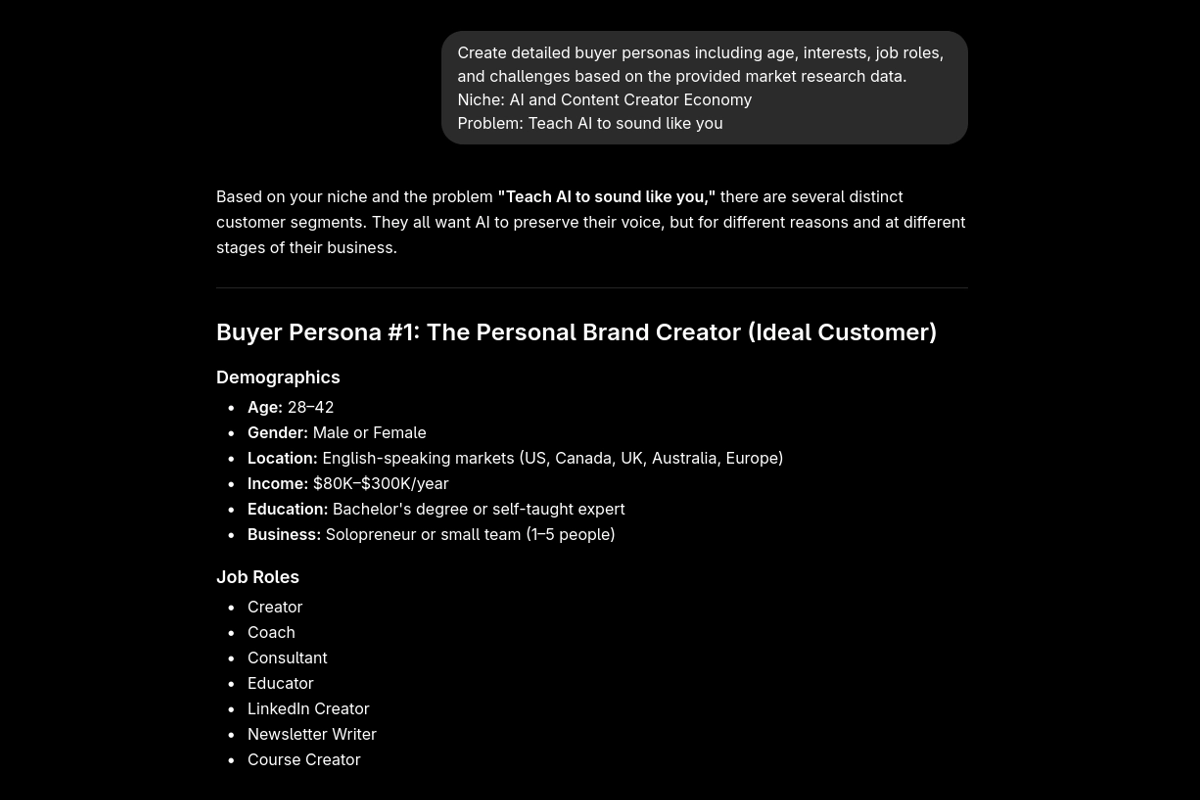
Once you’ve identified your audience’s problems… Turn that research into a detailed buyer persona.
Create detailed buyer personas including age, interests, job roles, and challenges based on the provided market research data.

Niche: [Niche]
Problem: [Problem or Pain Points]
A buyer persona helps you understand:
This makes your product, messaging, and marketing much more focused.
ChatGPT will typically generate information like:
This gives you much more than demographics.
It gives you context.
For example, your ideal customer might not simply be:
A content creator.
Instead, they might be:
A 32-year-old solo creator juggling a full-time job while trying to grow a YouTube channel. They use AI every day but spend hours rewriting the output because it never sounds like them. They’re looking for a practical system—not another 10-hour course.
That’s someone you can write for.
And when you write for one specific person…
Your marketing becomes dramatically more persuasive.
Your product name is often the first thing people notice.
If it’s vague, people won’t click.
If it’s confusing, they won’t remember it.
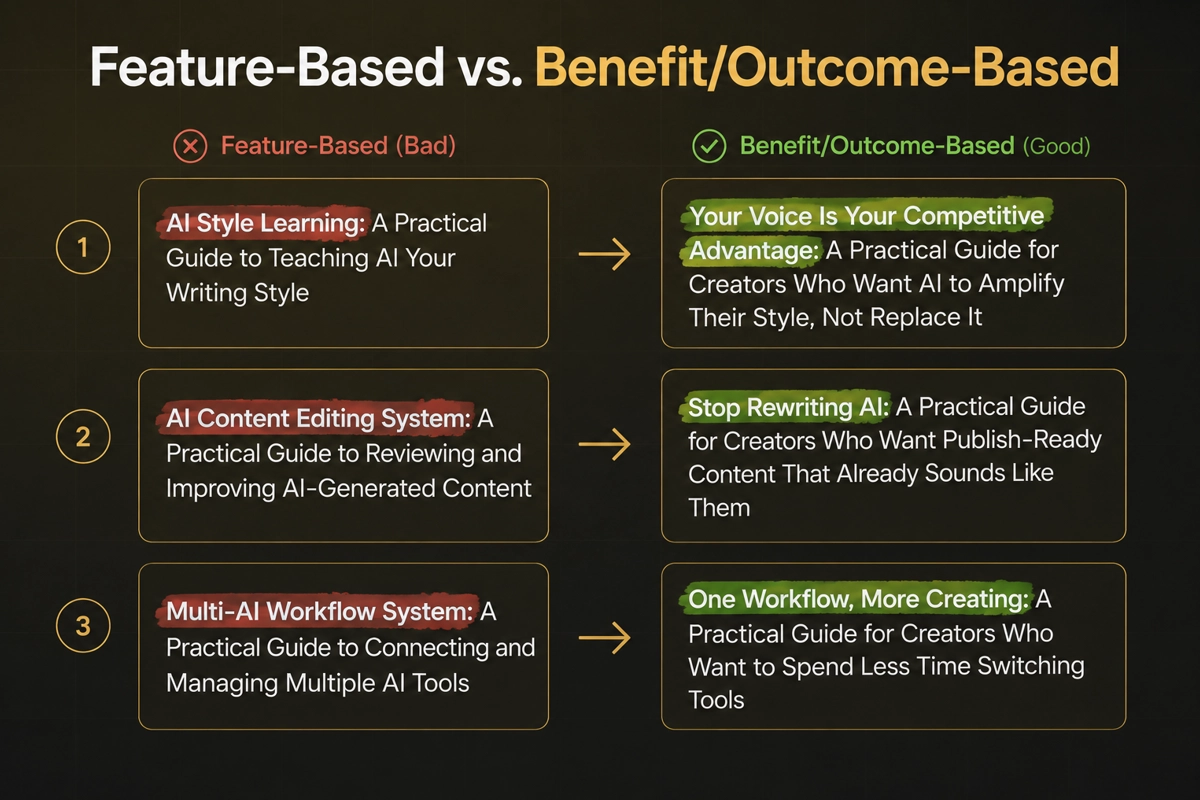
The best product names clearly communicate the outcome your customer wants.
Use this prompt:
Write 10 titles for my digital product around a specific niche that solve a specific problem. Make sure the title includes stats or data points.

Product Format: [Product Format]
Pain Point: [Pain Point or Problem]
ChatGPT generates multiple options that focus on benefits instead of features.
Benefits sell a product. They tell customers what to expect from your product.
Your product name should:
Suppose we’re creating a PDF Guide around this problem:
Teach AI to sound like you.
ChatGPT might generate titles like:
These titles are a great starting point.
Don’t feel like you have to use them exactly as they’re generated.
The goal isn’t to find the perfect title on the first try.
It’s to find a title that immediately communicates the outcome your audience wants.
Clarity almost always beats cleverness.
ChatGPT is an incredible research assistant. But it’s not perfect.
Avoid these common mistakes:
ChatGPT is excellent for:
However, it should complement other forms of product research, not replace them.
You should still validate your ideas using:
Combining AI with real-world data gives you the best chances of building products people want.
ChatGPT can save you hours of product research and help you find products you never thought of!
You can follow a repeatable process that starts with customer problems and ends with market-ready product ideas.
Here’s the workflow:
If you want to organize all of your research in one place, download the Product Research Sheet.
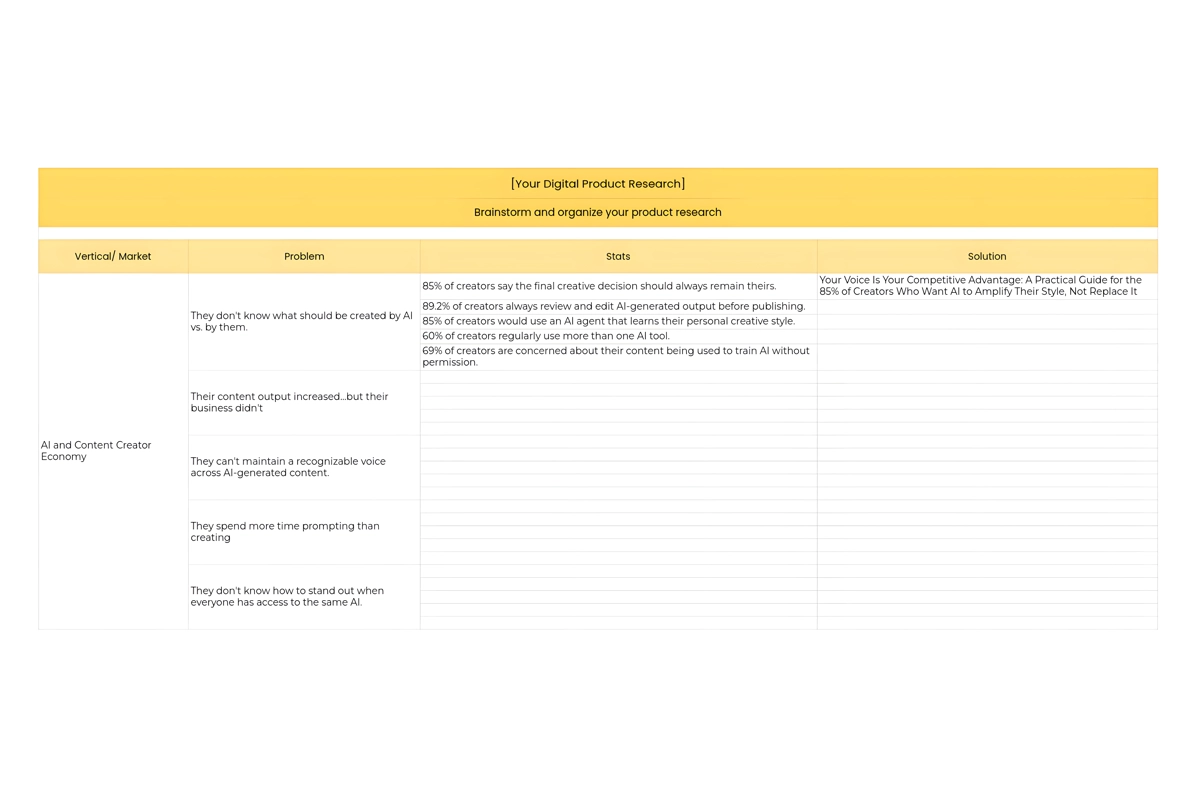
It includes every prompt from this guide with a workflow to help you research you next product idea.
Good luck with your next product launch!

Increase your online course sales with ChatGPT's 13 effective strategies for crafting captivating titles. Download the prompts template and write titles faster.
Find the best ChatGPT prompts for YouTube Keyword Research. Get content ideas, keywords, trends and much more – Just copy paste thesse prompts!