
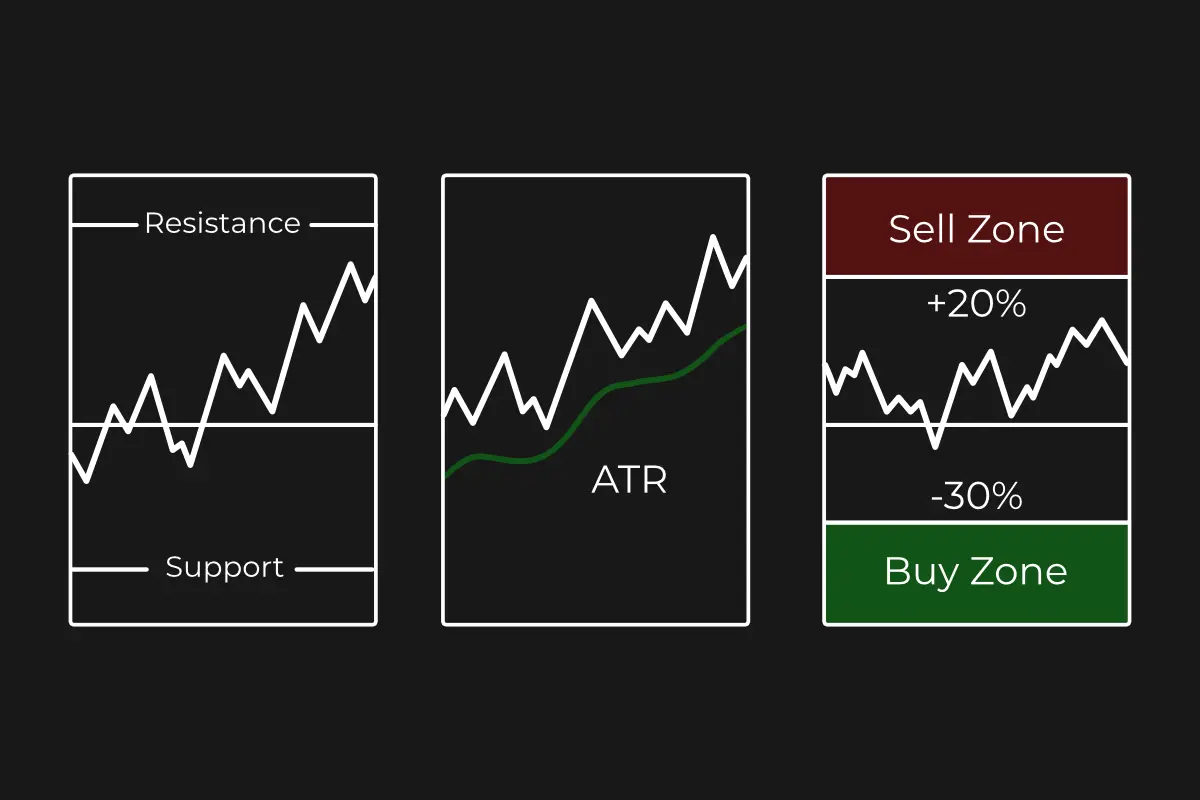
How To Set Price Ranges For Crypto Grid Bots
Price ranges make or break your grid bot. This guide shows 3 strategies, when to use them, and how to match them to any coin or market phase.

If you’ve spent any time in crypto trading, you already know one thing:
The crypto market never sleeps.
Prices swing up and down all the time. While that can be stressful for manual traders, it’s exactly where crypto grid bots shine.
Grid bots thrive on volatility. They’re designed to buy low, sell high, and repeat the process all over again.
A grid bot doesn’t think for itself. It only follows instructions. That means your success depends on when you decide to start the bot and how well you’ve prepared.
So, how do you know the right time to flip the switch? Let’s walk through a simple method that helps you launch grid bots at the most profitable moments.
Before you even think about running a grid bot, it pays to do a little homework. You don’t need to be a charting wizard, but you do need the right tools and a plan.
Take Bitsgap, for example. It’s one of the most popular platforms for running grid bots, and it provides plenty of useful data. But even if you use another bot, the same principles apply.
A tool like TradingView will help you visualize price ranges, and set the grid bot price range.
I also recommend keeping a tracking sheet. This lets you record percentages, manage your risk, and avoid staring at charts all day.

On Bitsgap, you’ll find backtest results showing how a trading pair has performed over the last:
Write these down.
When you see how the data stacks up across timeframes, it gets easier to filter out weaker setups and select better opportunities.
You can also enter the inputs and save the backtest result for those specific settings.

With WunderTrading (another grid bot tool), it’s easy:
You will then have the backtest for the best possible scenario with the best number of grids for the last 15 days.
Once you’ve laid the groundwork, you need to figure out when is the right moment to actually start your grid bot. This strategy focuses on a few reliable signals that show up again and again in crypto markets.
First up: parabolic moves. You’ve seen them before. A coin skyrockets, only to tumble back down. These moves can look intimidating, but they often create the best entry points.

Here’s a simple rule. If a coin jumps by around 75% and then drops by about 30% from its high, that’s usually a strong buying signal.
Think of it as catching the dip after the hype cools off. You’ll often spot these moves on 6-hour, 8-hour, or daily charts. Zoom out a little, and they’ll become much easier to see.
This pattern becomes even more significant if it happens within a sideways market.
Sometimes, instead of a big pump and dump, a coin keeps trading sideways.
Draw a box around the highs and lows of a coin’s recent price action. If the current price is in the lower half of that channel, that’s a good place to start your bot.

Why? Because it positions you closer to support levels, where the bot can buy low and sell into the upper range.
Last but not least, look for double bottoms. This is a fancy way of saying the price has tested the same support level at least twice.

Each retest makes that level stronger. If you see candles bouncing off the same support zone, it’s often a sign of stability.
Starting a grid bot near that level increases the odds of profitable trades over the next week or two.
By now, you’ve gathered data, spotted parabolic moves, checked for sideways channels, and even found a solid double bottom. The final step is to choose the pair that checks the most boxes.

Sometimes you’ll have many good options. In that case, lean toward coins in trending categories or ones you already believe in long-term.
You’ll feel more confident running a bot on something you understand. The key is not to force it. If none of the pairs line up with these signals, it’s better to wait. Remember, patience is also part of the strategy.
Starting a crypto grid bot at the wrong time is one of the fastest ways to end up frustrated. But with a little preparation and a few simple signals, you can increase your chances of success.
The formula is straightforward:
This approach keeps your trading methodical, low-to-medium risk, and profitable.

Price ranges make or break your grid bot. This guide shows 3 strategies, when to use them, and how to match them to any coin or market phase.
This guide explains investment allocation, price ranges, grid density, and advanced features to maximize profits in crypto trading.
Turn crypto grid bot profits into long-term wealth! Learn fund allocation, track earnings, and reinvest in CeFi, DeFi, staking, and more for passive income.